Category: Spotlight

TO PROMPT OR NOT TO PROMPT ?

Like a tightrope walker who knows he may not need the safety net, but feels safer in the knowledge that it is there, so some actors feel the need have a net of their own. It is not one the audience will see, but it is one that, if used, they will hear.

It is, of course… er…’

The prompt……………..’   

‘What?’

  (Louder)                 

‘THE PROMPT’………….!!
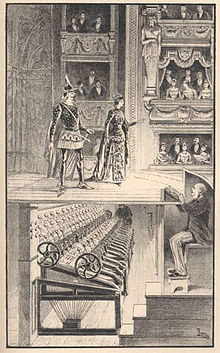
The prompter (sometimes prompt) in a theatre is a person who prompts or cues actors when they forget their lines or neglect to move on the stage to where they are supposed to be situated.

In truth, there is nothing better than knowing your lines. I do not just mean in an ‘Oh, I knew this yesterday,’ kind of way, but an ‘I know these lines so well, they’re almost part of me’. For an actor, learning the lines is where you start not where you finish. It is the least a paying audience deserves. It is only when books are down, faces lifted out of scripts and eye contact made that  the real work can begin with your fellow actors, and relationships built.

A 19th-century prompter at work.

If you have ever taken a prompt, you will know the feeling. The lurch of the heart as the words fail you and the seemingly eternal wait for the prompt to notice. The look of panic in the eyes of your fellow cast members. What do they do, cover for you, and wait for the line to come? The scene becomes a frozen tableau of inaction, everyone waiting for something to happen.

An audience may tolerate a prompt or two ( it happens to the best of professional actors). They feel embarrassed for you, nervous that you will do it again. Perhaps even, dare I say it, disappointed? Far better to know your lines so well, that you can recite them in your sleep (actually, reciting them as you fall asleep is often a good way to make them stick – you will be surprised by how much is retained in the morning). Far better for you and your cast members to know the play so well that, should the worst happen, you can get back on track. The greatest thing a rehearsal process can bring to a cast is the feeling of trust.

Directors; be brave. Tell your cast from the first rehearsal, that they will be performing without a prompt. Tell them they will not need it, and then see how hard they work to fulfil your prophecy. They will amaze themselves.

Remember, your audience want you to succeed.

Why not reward them by doing just that?

Richard Nicholas James


A DAY IN THE LIFE OF AN AMATEUR THEATRE DIRECTOR


A day in the life of an Amateur Theatre Director is a delightful mix of creative vision, problem-solving, and occasionally, a healthy dose of chaos. It’s a role that demands passion, patience, and the ability to wrangle a group of enthusiastic, albeit sometimes slightly eccentric, individuals. It’s a journey filled with laughter, frustration, creative breakthroughs, and the occasional prop-related disaster. But above all, it’s about bringing a vision to life, fostering a sense of community, and celebrating the joy of theatre.

After the reading of a play  the exciting/ nervous time is the casting of the chosen production. Always remember what it was like when you  auditioned for a role. Kindness counts. Be positive and encouraging throughout the process.  Once you have communicated the cast list to all who have shown interest in being part of the production the first read through of the script happens. All your cast are looking forward to hearing each other and knowing what the Directors vision is.

In rehearsals you guide actors through scenes. Deciding on the exact placement of actors on stage,( Blocking ) which can involve creative solutions to overcome limited space. Ensuring that your vision is successfully coming to life. by giving clear direction and boundaries. Occasionally, amidst the chaos, there will be a magical moment where the actors click, the scene comes alive, and the director feels a surge of creative energy. This is often followed by a celebratory high-five (or a quiet internal fist pump).

Throughout the whole process, you will need to manage admin tasks, communicate with the team and balance artistic goals with practical constraints like budgets. During technical rehearsals, sound and lighting elements are incorporated into the play, overseen by the technical designers. There will also be dress rehearsals with all costume, set and props.  Despite the demanding work, collaborating with talented artists to bring stories to life on stage can be highly rewarding.

“It’s all about the process”.

Meaning, that opening night is not the only important part.  And whether every seat in the house is full does not determine the success of a show.  It means that EVERY rehearsal is important to the outcome, as well as being part of the fun!   Every dance rehearsal, every crew painting session, every tech rehearsal, and even the strike is part of the overall performing arts experience and part of the fun.

Plus there is a bittersweet feeling of knowing that, while all those exhausting hours are FINALLY over, the “living work of art” that once was your production, is now gone forever and just a memory.  You can never go back.  If your best friend missed the show, “sorry”, it’s too late.  You can never have THAT cast and THAT set and THAT audience together in one place ever again.  Unlike fine art that hangs in a gallery for hundreds of years, our chosen form of “performance art” is very fleeting…

In Conclusion:

Being a director in amateur theatre is a demanding, yet incredibly rewarding experience. 

Do you miss it when it comes to an end? DEFINITELY!  So what do you do? All you can do is grin and daydream about the next production coming up soon.

BREAK A LEG DARLING, YOU’LL BE FABULOUS!

THE ORIGINS OF ‘BREAK A LEG’

Why do they say, “Break a Leg “in Theatre?

If you have been to a theatre performance, odds are you have heard the term “break a leg,” and maybe even used it to wish performers good luck. It may seem odd, but in the theatre world, saying “good luck” is considered to bring bad luck. There are numerous ideas about the origin of the phrase. One story says spirits wreak havoc on your wishes and make the opposite happen. Another comes from ancient Greece, where the audience did not clap but instead stomped their feet to show appreciation. If the audience stomped long enough, they would break a leg. Some say the term originated during Elizabethan times when, instead of applause, the audience would bang their chairs on the ground — and if they liked it enough, the leg of the chair would break. 

Bowing or Curtsying

The term “break a leg” may refer to a performer bowing or curtsying to the audience in the metaphorical sense of bending one’s leg to do so. The saying could originally express the hope that an enthusiastic audience repeatedly calls for further bows or encores. This might cause a performer to “break” the leg line. Much earlier in stage history, when superstition had a less frightening hold on the craft, actors and their followers used a more gracious greeting: “May you break your leg,” by which it was meant that the evening’s performance would be of such grandeur that the actor would be obliged to break his leg – that is, bend his knee – in a deep bow acknowledging the audience’s applause.

The Performer Breaking the Leg Line

The most common theory refers to an actor breaking the “leg line” of the stage. The edge of a stage just beyond the vantage point of the audience forms a line, imaginary or actually marked, which is called the “leg line,” named after a type of concealing stage curtain: a leg. For an unpaid stand-by performer to cross or “break” this line would mean that the performer was getting an opportunity to go onstage and be paid; therefore, “break a leg” might have shifted from a specific hope for this outcome to a general hope for any performer’s good fortune.

Evidently, in the days of early vaudeville, the producers would book more performers than could possibly perform in the given time. In order to ensure that the show did not start paying people who do not actually perform, there was a general policy that a performer was NOT paid unless they actually performed on-stage. Nowadays the term is used to wish an actor all the very best for a good performance and a successful run. No matter which version you choose to believe well wishes are always appreciated and as amateur performers, we still use the term. Invariably, producers, directors and fellow cast members pop their heads around dressing-room doors for a quick chat and a cheery,

“Break a Leg Darling, You’ll be Fabulous”

ZOOM WITH A VIEW

March Madness

Abbey Drama were mid-rehearsal when the first lockdown was announced. The news headlines were reporting a new SARS-like virus that reportedly came from the livestock meat markets of Wuhan .

In mid-March 2020, our group along with the rest of the UK , were legally obliged to commit to lockdown measures to prevent the spread of the virus. “Hands, face, space” became the mantra as we rubbed our hands raw with alcohol gels and donned smile-hiding face masks to attend to the only permitted activity of buying essentials. We stopped hugging, and helping strangers out, and even shaking hands was disallowed. It became an alien world, like something from the movies. Except that it wasn’t, it was our lives, our community, and our Drama Group.

Of course, we all took it all in our stride, thinking that worst case scenario, the production dates might be pushed back a tad.  Personally, I plunged myself into this altered reality with more than a pinch of disbelief at what was happening, little knowing that 16 months on, I would still be unable to meet up with friends in the rehearsal space, or any other space for that matter.

Embracing The New

As it became crystal clear that everything was going to be anything but clear for the foreseeable, a collective from Abbey Drama decided to reconvene on a Monday evening to oxymoronically “meet remotely” via Zoom or Skype (other video conferencing software is available). In addition to the popular productions that the group are so well known for, the Ab Drams have always enjoyed regular play-readings as a group and of course, this lends itself well to video conferencing. In a heartbeat, we were off, and we started with David Muncaster’s Community Spirit.

“You’re Still on Mute!”

Everyone was new to video call meetings back then and much hilarity ensued as we tried to log on, puzzled over strange camera angles, and failed to take ourselves off mute again, and again, and again. But we soon left the technical hitches in the ditches and what joy to see those familiar faces and hear the tones of those voices we knew so well. Not every Ab Dram member has joined in, but everyone is welcome and in fact, we have embraced fellow thespians from other drama groups who now make up a vibrant part of our happy throng. “Monday evening play reading” sounds clichéd, perhaps Alan Bennet would like to produce a script bearing the title.

The Zoom Womb

Since that first Zoom play-reading in March 2020 we have read upwards of 30 scripts including The Constant Wife (W Somerset Maugham), The Cherry Orchard (Anton Chekhov), Steel Magnolias (Robert Harling) and The Vicar of Dibley (Richard Curtis, Paul Mayhew-Archer) naming a few to illustrate that the plays are wide and varied. We also read a script that one of our members had written.

But more than getting to know the good, the bad and the ugly in terms of plays that are out there we got to connect with others. During the unsettling and ever-extending days of social restriction, we created a virtual space that was warm, welcoming, nurturing and nourishing. A Zoom womb if you like.

It has been a difficult time for many, but Ab Dram has continued to see and connect with its members albeit through the portals of smartphones, tablets, laptops, and computer screens. We have laughed, shared, checked up on one another and managed to maintain some sense of normality in these unprecedented times.

We have shared our thoughts on the plays we read and how they relate to today. We have giggled at and embraced dodgy accents and mispronunciations. There is no judgement in our group, the laughter is shared. This is a safe space to try out early attempts at an accent or dialect and sometimes the outcomes are truly hilarious but there is no malice and absolutely no pressure on anyone to attempt any accent. You read as you want to read. Or you can choose to tune in as a silent member and enjoy the experience of what is a rough approximation of an unedited Radio 4 drama. We have debated the merits (and otherwise) of various plays and pondered the potential of putting them on as a group in the future. We have also shared in passing what is happening in our own individual lockdown lives and smiled at the on-screen faces of those we haven’t seen in person for over a year. It has been so much more than a regular play reading group.

Future Freedoms.

I wonder if our current Prime Minister, Boris Johnson will allow us into the rehearsal space and welcome our lovely audiences back into the less-than-socially-distanced seating area of our theatre any time soon?

I hope so.

Oh, but I shall so miss our Zoom play readings when they come to an end.

Perhaps it is the languid, lazy part of me that enjoys barely having to move two feet to plug in, recline in my own chair with my current drink of choice, slippers on and script to hand. There really is something quite comforting about engaging with the Ab Drams whilst faintly hearing my family in the next room watching TV and then having the dog wander up occasionally for a quick tummy tickle. Social convention falls by the wayside during unprecedented times and whilst I have not logged in wearing hair curlers yet, I am very relaxed about what I’m wearing and there has been at least one incident of members wearing pyjamas. You see, despite being remote, our play-readings are homely, warm, and intimate.

Perhaps Zoom will continue to be part of the organisation in one form or another.

That said, I can’t wait to see everyone in the flesh again, to move in the space and see great writing in action.

So finally, whilst reflecting on our Zoom play-readings with great affection, as we approach the end of the third and hopefully last lockdown, I am looking forward in great anticipation that maybe, just maybe, we will be back strutting the SURC’s boards very soon.

Symantha Simcox   July 2021


ACT 1 BEGINNERS PLEASE !

But wait!

-where are the lights? We often take lighting for granted but the more you know about lighting the more you can engage your audience and impress them with a memorable experience. Learning about stage lighting sometimes seems a mystery to those of us who Tread the Boards, so to speak. Lighting design and technology can seem like black magic with all its strange terminology and jargon.
As a Drama Group, we were very fortunate to obtain a grant, which we used to purchase our own lighting rig and kit. Knowing what was required was beyond our knowledge and we only knew what to purchase because a young man of fourteen advised us!

Who is the young man you ask?
His name is Tom Mulliner and we at Abbey Foregate (SURC) Drama Group were very fortunate to obtain Tom’s expertise in lighting. He had always been involved in lighting school musicals and offered to work with us on our productions. A young man with such talent was always going far in his chosen profession and after lighting approximately eight plays Tom was off to college to gain more knowledge.

He is now based in Ipswich and working professionally as a lighting programmer. Tom’s work takes him far and wide to many venues around the world and to date he has worked in over 130 theatres! The more recent productions he has worked on are Tell Me On a Sunday (UK Tour), Be More Chill (West end), &Juliet (West end), Leopoldstadt (West end), Charlie and the Chocolate Factory (Sao Paulo) and Titanic (UK Tour).
Catching up with Tom, he informed me that the past fifteen months have been very quiet in terms of theatre work. It is now starting to pick up again and he is currently working on ANYTHING GOES at the Barbican, which opened on Friday 23rd July 2021.
Tom was so pleased that we have productions in the pipeline for the future and” hopes they go well and the group go back to doing what they do best!”
As I mentioned before a young man with such talent was always going to go far in his chosen profession and that is what has happened to Tom. We are so proud that in his early days he worked with us on our productions and send him all our thanks and best wishes for the future.

PHP Code Snippets Powered By : XYZScripts.com